The contractor marketing field guide
Email Marketing
for Contractors.
Turn past clients and old estimates into booked jobs. A practical guide for GCs, remodelers, and home builders.
Your best leads are already in your phone, QuickBooks and inbox. They’re past clients and estimates that never closed. Email marketing for contractors is the cheapest way to turn them into booked jobs. This guide shows GCs, remodelers and home builders how to do it without becoming full-time marketers.
Key takeaways
- Email marketing for contractors works because it reaches people who already know you: past clients, open estimates and referral partners.
- The estimate follow-up sequence pays back fastest. Send three short emails over 30 days after every proposal.
- Ask for a Google review at closeout and a referral a few weeks later.
- Segment your list (open estimates, active clients, past clients, lost bids, referral partners) so every email is relevant.
- Most contractors can set up the core emails in a weekend using their CRM plus a basic email platform.
What is email marketing for contractors?
Email marketing for contractors is the practice of sending planned, permission-based emails to past clients, open estimates and referral partners to win repeat work, close more bids and earn referrals. For GCs, remodelers and home builders, it centers on estimate follow-ups, review requests, seasonal offers and a simple project newsletter.
Why email marketing for contractors works
Most contractors chase new leads and ignore the ones they already paid for. Every homeowner who hired you, every person who asked for a bid, every realtor and designer who sent you work is a contact you’ve earned. Most of them never hear from you again.
Email fixes that, for three reasons:
- You own the list. Leads from Angi, Thumbtack, HomeAdvisor and Google Ads are rented. The platform sets the price, changes the rules and sells the same lead to three other contractors. Your email list belongs to you.
- Remodeling is a long, repeat game. A homeowner who did a bathroom with you in 2024 may want a kitchen in 2027. If you’re not in their inbox when that moment comes, they’ll Google someone else.
- Referrals need a reminder. Happy clients want to refer you. They just forget your name. A few emails a year keep it top of mind.
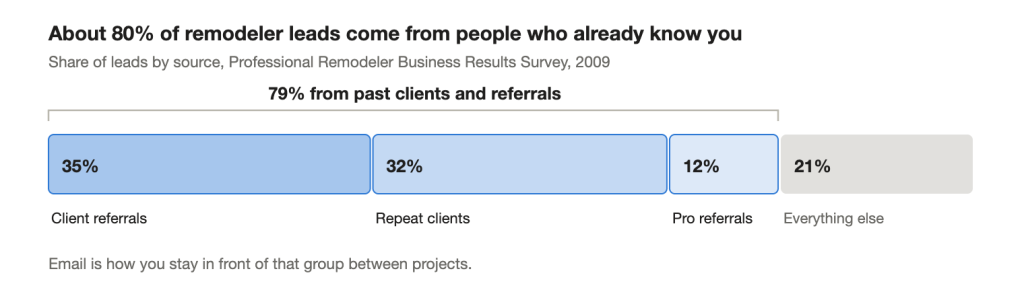
Most remodeling work already comes from past clients and the people they send your way. That’s exactly the group email reaches.
This isn’t about blasting coupons every week. For a contractor, email marketing comes down to three jobs: follow up on estimates, stay in touch with past clients, and ask for referrals and reviews at the right moment.
Pros and cons of email marketing for contractors
Email is worth it for almost any contractor with more than a year of past jobs. Here’s the honest trade-off.
| Pros | Cons |
|---|---|
| Repeat work from past clients without paying for leads | Takes time you’d rather spend on jobsites |
| More referrals, because people remember your name | Easy to sound salesy to people you know personally |
| Higher close rate when estimates get consistent follow-up | Messy contact data spread across QuickBooks, texts and paper |
| Fills the calendar in slow months with seasonal offers | Spam complaints if you email people who never opted in |
| Costs little compared with lead-gen platforms | Results build slowly over months, not days |
Most of the cons go away with automation and a short, plain writing style. A follow-up you set up once keeps working on every estimate after that.
The 9 emails that make contractors money
Forget most of what ecommerce email advice tells you. A contractor needs these nine emails, roughly in order of how much money they bring in.
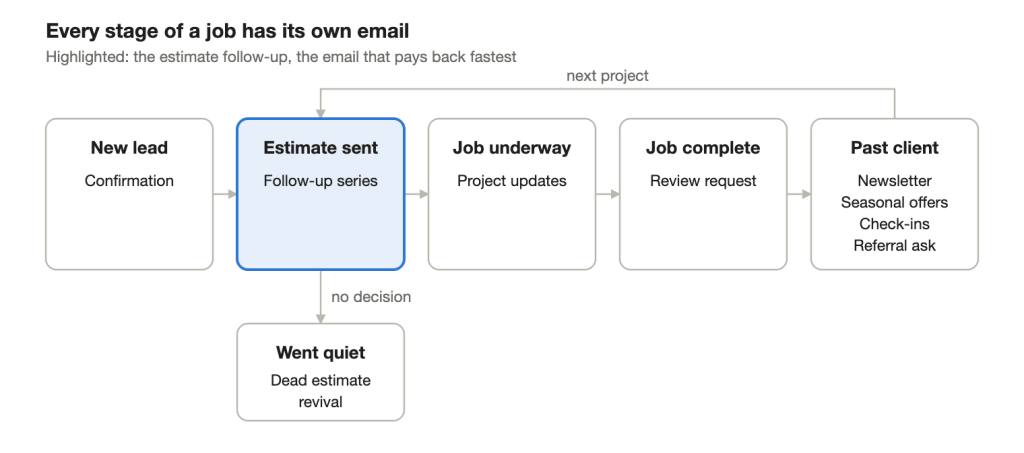
Each stage of a job triggers its own email, and past clients loop back to a new estimate.
1. Estimate follow-up
This is the contractor’s version of the “abandoned cart” email, and it’s the most valuable email you’ll ever send. Homeowners rarely say no to a bid. They go quiet, get busy, or wait for a nudge. A short series of 3–4 follow-ups after you send a proposal wins back jobs you’d otherwise lose to whoever called last. For the bigger picture, see why remodeling leads go cold and the follow-up system that keeps them moving.
2. Estimate request confirmation
This goes out the moment someone fills out your contact form. It thanks them, explains what happens next (site visit, timeline, what to have ready) and sets expectations on budget. It makes you look organized and quietly screens out people who aren’t serious.
3. In-project updates
This is a weekly or milestone email while the job is running: what got done, what’s next, any decisions the client needs to make. It cuts down on “what’s going on?” calls and sets up a great review later.
4. Review and referral request
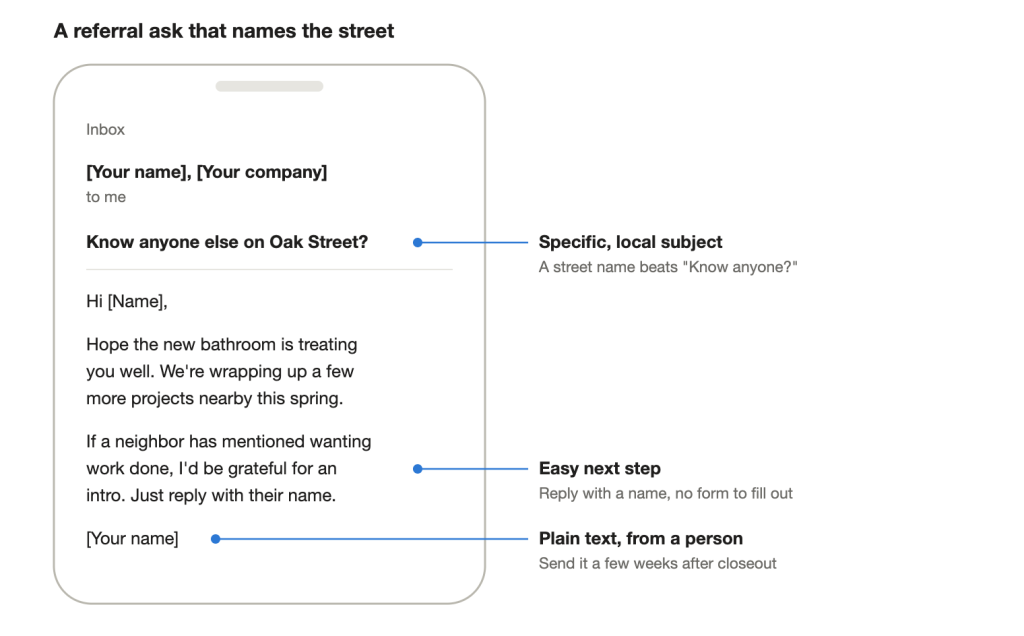
Send it at the final walkthrough or within a week of closeout, while the client is happiest. Ask for a Google review first, since reviews also feed your local SEO. Ask for a referral a few weeks later, after they’ve lived with the work.
5. Seasonal offer
This is the contractor version of a promotional email. Tie it to the calendar: deck and patio season in early spring, “get your kitchen done before the holidays” in late summer, storm repair after bad weather, and booking for next year in the winter slowdown.
6. Project showcase newsletter
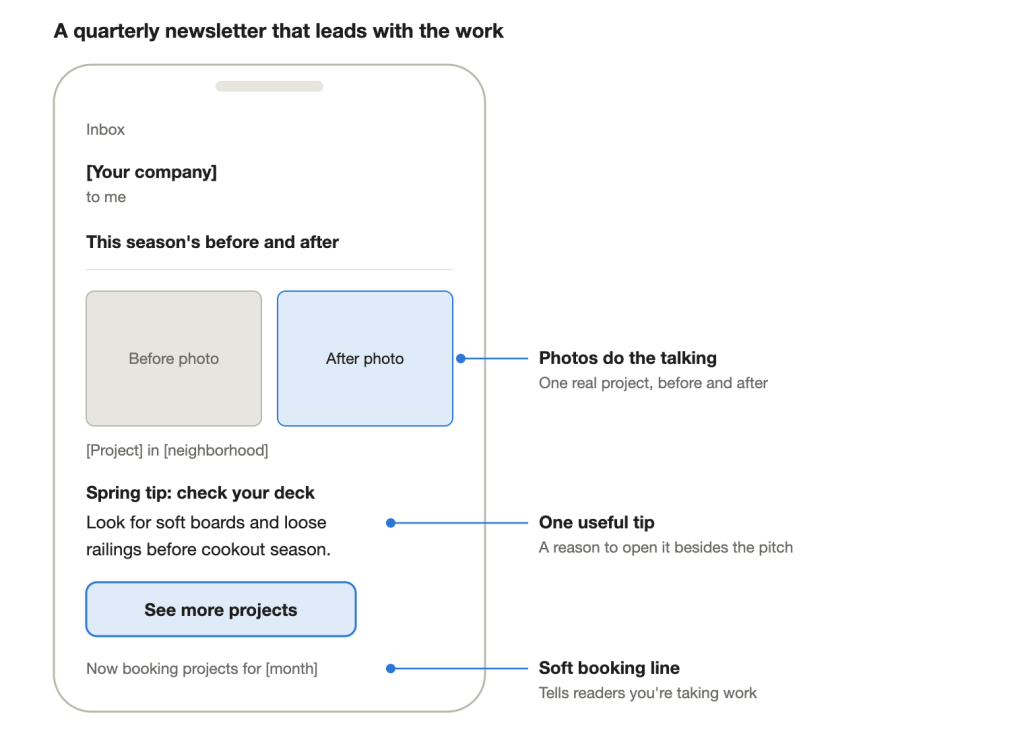
Send it monthly or quarterly. Include one recent before-and-after, one useful homeowner tip, and a line saying when you’re booking. Keep it short. Its job is to remind people you exist and show off your work. Our guide to before-and-after content for remodelers shows how to turn finished jobs into material for it.
7. Dead estimate revival
This is the contractor’s re-engagement email. Go back to bids that went cold 6–18 months ago. Plans change, budgets come back and the contractor they picked instead may have fallen through. A simple “still thinking about that project?” email costs nothing and regularly turns up work.
8. Maintenance and anniversary check-in
A year or two after a job, check in: “Your deck is two years old, time to reseal,” or “How’s the kitchen holding up?” It’s genuinely helpful, it often turns into small paid service work, and it keeps the relationship warm for the next big project.
9. Announcements and invites
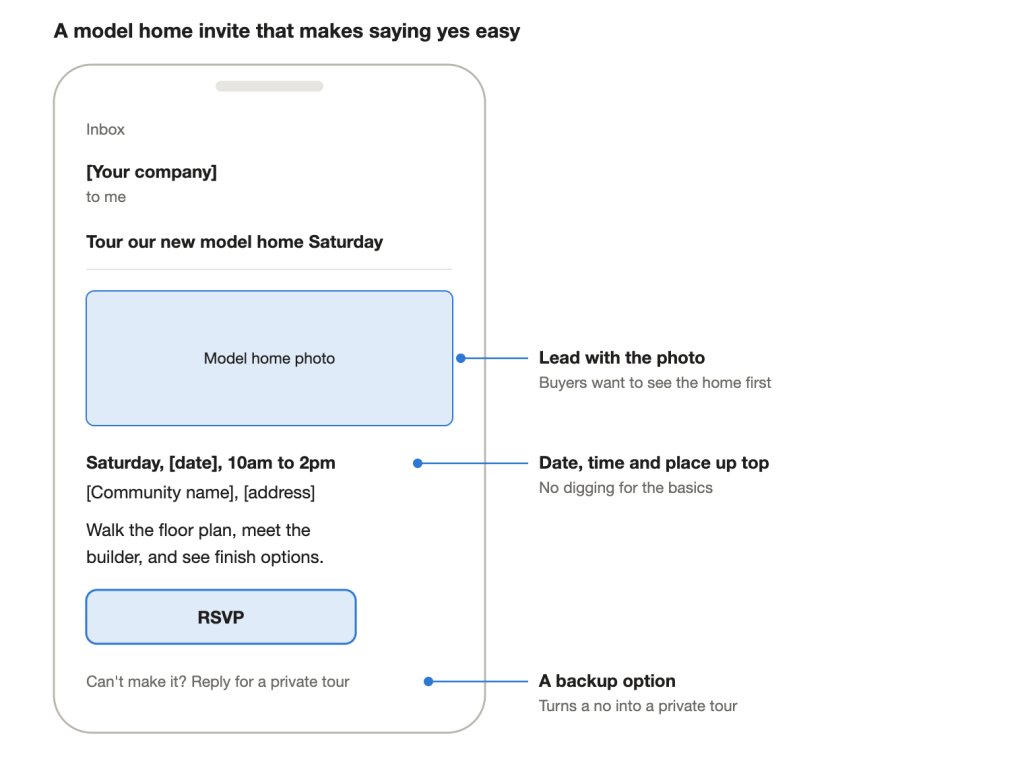
Use these for news worth sharing: a new service line, a new showroom, an award, or a new hire. Home builders can use invite emails for model home tours, open houses, and design-center events.
Real examples worth borrowing from
You won’t find many great examples of email marketing for contractors in the wild, but brands in other industries have already solved the same problems. These are from Really Good Emails, a free library of real marketing emails. Click through to see each one.
| Contractor email it maps to | What to borrow | |
|---|---|---|
| “Let’s go back to the weekend, please”, Tripadvisor | Review request | Ask for the review by bringing back the good memory, not by asking for a favor. Try “Remember move-in day?” |
| “How was it? Rate Dwell Open House: Los Angeles!”, Eventbrite | Event follow-up for builders | A short “How was it?” sent right after a model home tour or open house, naming the event |
| “Book a 5-star space”, Neighbor | Seasonal offer, project showcase | Put your star rating and real client reviews in the email itself, not just a link to Google |
| “Let’s get your project started”, Crew | Estimate request confirmation | A subject line that sounds like the work is already moving |
| “Re: Next Steps”, Crew | Estimate follow-up | A reply-style subject that reads like a one-to-one conversation, not a campaign |
| “Checking in”, Sundays | Maintenance check-in | Two plain words. Nothing about it looks like marketing |
| “These reminders don’t seem to be working”, Duolingo | Dead estimate revival, the “close your file” email | Admits you’ve emailed before without an answer. That honesty is what gets the reply |
| “Do you know Brad Prescott, Justin Lake or Christine Laikimd?”, Strava | Referral ask | A specific ask beats “know anyone?” Try “Know anyone else on [street] thinking about a remodel?” |
| “Just dropped: new homes”, AvantStay | New inventory for builders | A short “just dropped” announcement for new listings or lots, led by photos |
For more, browse the site’s follow-up, review, referral and re-engagement categories.
How to set up email marketing for contractors in 5 steps
You can get a working email system running in a weekend. Here’s the order to do it in.
Step 1: Pick your tools
Start with what you already pay for. Many contractor CRMs and project management platforms already send automated estimate follow-ups and client updates. Use those first, because they’re tied to your actual jobs and proposals. If you’re still choosing one, start with our roundup of the best contractor proposal software.
For newsletters and seasonal offers, add a basic email platform like Mailchimp, Brevo or ActiveCampaign. Look for three things: easy contact import, tags or lists for segmenting, and simple automations.
Step 2: Build your list from what you already have
You don’t need pop-ups or discount codes. Your list is already sitting in these places:
- Past invoices and customers in QuickBooks or your accounting software
- Every estimate request from your website, phone and lead platforms
- Your phone contacts and text threads with past clients
- Realtors, designers, architects and trade partners who’ve sent you work
- Home show and event sign-ups
To keep it growing, add these:
- A yard sign QR code on every jobsite that links to your portfolio and a sign-up form
- A lead magnet on your website, like a local remodel cost guide or a “what to know before you renovate” checklist
- An opt-in checkbox on your estimate request form and contract (our remodeler’s website checklist covers where these belong)
One rule: only email people who gave you their address in a business context. Past clients and estimate requests count. A purchased list doesn’t, and it’ll get you flagged as spam.
Step 3: Set goals that mean money
Pick one or two to start:
- Close more of the estimates you send
- Get more repeat jobs from past clients
- Get more reviews and referrals
- Fill the slow season
Your goal decides which emails you set up first. For most contractors, that’s estimate follow-up, because it pays back fastest.
Step 4: Write and send your first campaigns
Write the way you talk to a client on site. Short sentences, no marketing hype, one clear ask per email.
- Subject line: plain and specific. “Quick follow-up on your kitchen estimate” beats “Exciting news from ABC Builders!”
- Body: 3–6 sentences for most emails. Use photos for showcase emails only.
- One call to action: reply, book a call, or leave a review. Not all three.
- Footer: your business name, physical address, phone and an unsubscribe link. US anti-spam law (CAN-SPAM) requires the address and unsubscribe option on commercial email.
- Cadence: automated emails go out when triggered. Newsletters go out monthly or quarterly. Seasonal offers go out 3–4 times a year.
Set up the automated emails once (estimate follow-up, request confirmation, review request) and they run on every job from then on.
Step 5: Track what actually matters
Open rates are a nice-to-know. These numbers tell you if email is working:
- Replies to your emails
- Consults booked from an email
- Estimates closed after a follow-up sequence
- Jobs from past clients and referrals each quarter
- New Google reviews after review requests
Clean your list a couple of times a year. Remove bounced addresses and anyone who asked to stop hearing from you.
Segment your list so every email is relevant
Sending the same email to everyone is the fastest way to get ignored, and it’s the most common mistake in email marketing for contractors. Tag every contact with at least one of these groups:
| Segment | Who’s in it | What they get |
|---|---|---|
| Open estimates | Bid sent, no decision yet | Estimate follow-up sequence |
| Active clients | Job under contract or in progress | In-project updates |
| Past clients | Job completed | Review request, newsletter, maintenance check-ins, seasonal offers |
| Lost estimates | Said no or went quiet 60+ days ago | Dead estimate revival, newsletter |
| Referral partners | Realtors, designers, architects, trades | Project showcase, a thank-you when they send work |
| New leads | Downloaded a guide or signed up, no estimate yet | Welcome email, newsletter |
Once you’re comfortable, also tag by project type (kitchen, bath, addition, outdoor, new build). That way your deck-season email only goes to people who’d care about a deck.
Copy-and-paste sample emails
These templates cover the core of email marketing for contractors. Swap in your details and send. Each one is short on purpose: homeowners read these on their phones between other things.
Estimate follow-up sequence
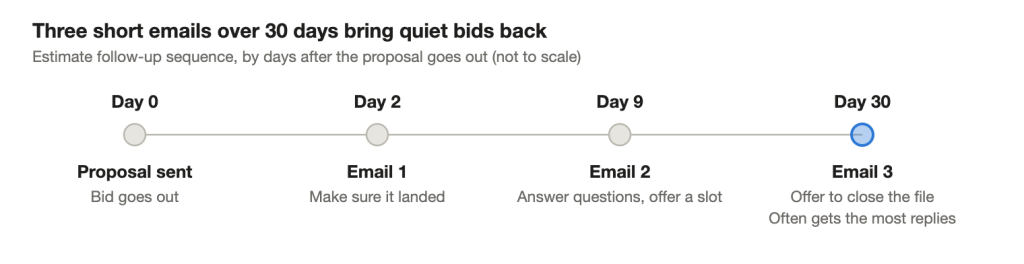
Set this up once in your CRM and it runs on every proposal you send.
Email 1: two days after sending the proposal
Subject: Your [project] estimate
Hi [Name],
Wanted to make sure the estimate for your [project] came through okay. Happy to walk through any line item, or adjust the scope if the number landed higher than you expected.
Easiest way to reach me is just replying here or calling [phone].
[Your name]
Email 2: one week later
Subject: Any questions on the [project]?
Hi [Name],
Most homeowners have a few questions after they’ve had time to look over a bid, usually about timeline, materials or payment schedule. Any of those on your mind?
We’re currently scheduling projects for [month]. If you’d like to hold a spot, let me know and I’ll pencil you in.
[Your name]
Email 3: three weeks later
Subject: Should I close out your file?
Hi [Name],
Haven’t heard back, so I’m guessing timing or budget shifted, which is totally normal. Should I close out your file for now, or would you like me to check back in a few months?
Either way, thanks for considering us.
[Your name]
The “close out your file” email often gets the most replies in the sequence. It gives people an easy, no-pressure way to answer.
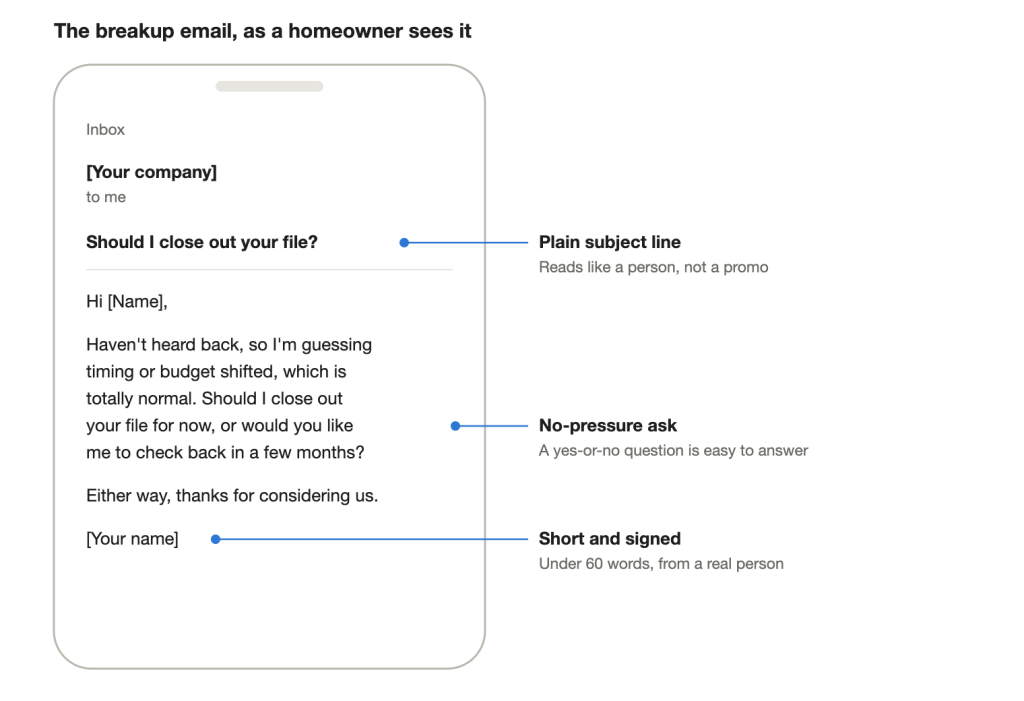
What makes it work: it’s short, it sounds like you, and it makes replying easy.
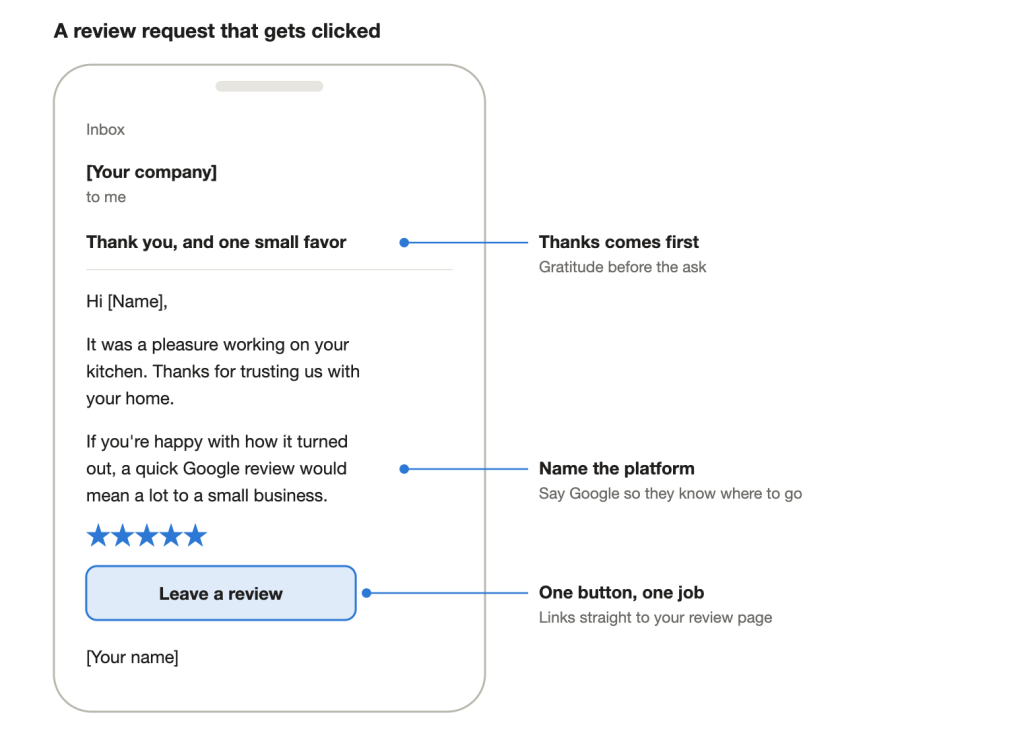
Review request
Subject: Thank you, and one small favor
Hi [Name],
It was a pleasure working on your [project]. Thanks for trusting us with your home.
If you’re happy with how it turned out, a quick Google review would mean a lot to a small business like ours. It takes about a minute: [review link]
And if anything isn’t right, reply here first and we’ll make it right.
[Your name]
Dead estimate revival
Subject: Still thinking about that [project]?
Hi [Name],
We put together an estimate for your [project] back in [month/year]. Plans change, so I wanted to check in. Is it still on your list?
If so, I’m happy to come back out and update the numbers. We have openings starting in [month].
[Your name]
Maintenance check-in
Subject: Your [deck/kitchen/roof] turns [X] this month
Hi [Name],
Hard to believe it’s been [X] years since we finished your [project]. Quick reminder: [one specific maintenance tip, e.g. “decks like yours do best with a reseal every 2–3 years”].
If you’d like us to take care of it, or you’ve got another project in mind, just reply.
[Your name]
Your first 30 days
Do these in order. By the end of the month, your follow-up runs on autopilot and your past clients know you’re still around.
Week 1: Gather your list
- Export past clients from QuickBooks or your invoicing software
- Pull every estimate from the last 2 years, won and lost
- Add realtors, designers and trade partners who’ve referred work
- Tag everyone using the segments above
Week 2: Set up the money emails
- Turn on (or write) the 3-email estimate follow-up sequence
- Set up the estimate request confirmation email
- Set up the review request to go out at project closeout
Week 3: Reach back out
- Send the dead estimate revival email to lost bids from 6–18 months ago
- Send a short “checking in” email to past clients with one recent project photo
Week 4: Plan the rest of the year
- Map out 3–4 seasonal offers on your calendar
- Pick a newsletter cadence (monthly or quarterly) and draft the first one
- Add a QR code to your yard signs and an opt-in box to your estimate form
- Write down your baseline: estimates closed, repeat jobs and reviews this month
Email marketing for contractors: FAQs
What emails should a contractor send?
Nine core emails cover most of the value: estimate follow-up, estimate request confirmation, in-project updates, review and referral requests, seasonal offers, a project showcase newsletter, dead estimate revival, maintenance check-ins, and announcements or invites. Start with estimate follow-up, because it closes jobs you already bid.
Is email marketing worth it for a small remodeling company?
Yes, if you have past clients or a steady flow of estimates. Estimate follow-up alone usually justifies the effort. It costs little and works on leads you’ve already paid to get.
How often should a contractor email past clients?
Monthly or quarterly is plenty, plus 3–4 seasonal offers a year. Past clients should hear from you often enough to remember your name, not so often that you feel like spam.
What should I send homeowners in the off-season?
Send booking reminders for spring projects, planning tips for next year’s renovations, and a recap of your best projects from the past year. Winter is also a good time for dead estimate revival emails.
Should I use my CRM or a separate email tool?
Use your CRM or project management software for anything tied to a specific job: estimate follow-ups, project updates, review requests. Use a dedicated email platform for newsletters and seasonal campaigns sent to your whole list.
How long should contractor emails be?
Short. Most should be 3–6 sentences with one clear ask. Project showcase newsletters can run a little longer because photos do most of the work.
Can I email people who requested an estimate but never hired me?
Yes. They reached out to you about a project, so follow-up is expected. Always include an unsubscribe link and honor opt-outs right away.
Do home builders need a different approach than remodelers?
The system is the same, but the emphasis shifts. Builders lean more on event invites (model homes, open houses), new community and inventory announcements, and longer nurture sequences for buyers who are 6–12 months out.
The bottom line on email marketing for contractors
You don’t need a big list or a marketing team. Start with the estimate follow-up sequence, add a review request at closeout, and send a short project showcase every quarter. Those three emails bring in most of the money, and once they’re set up they run on every job.
Sources
- Business Results Survey: Repeats and Referrals, Professional Remodeler, April 2009